Ecosystem Background

Why IDG-SM

Insurance Disintegration & Governance Model

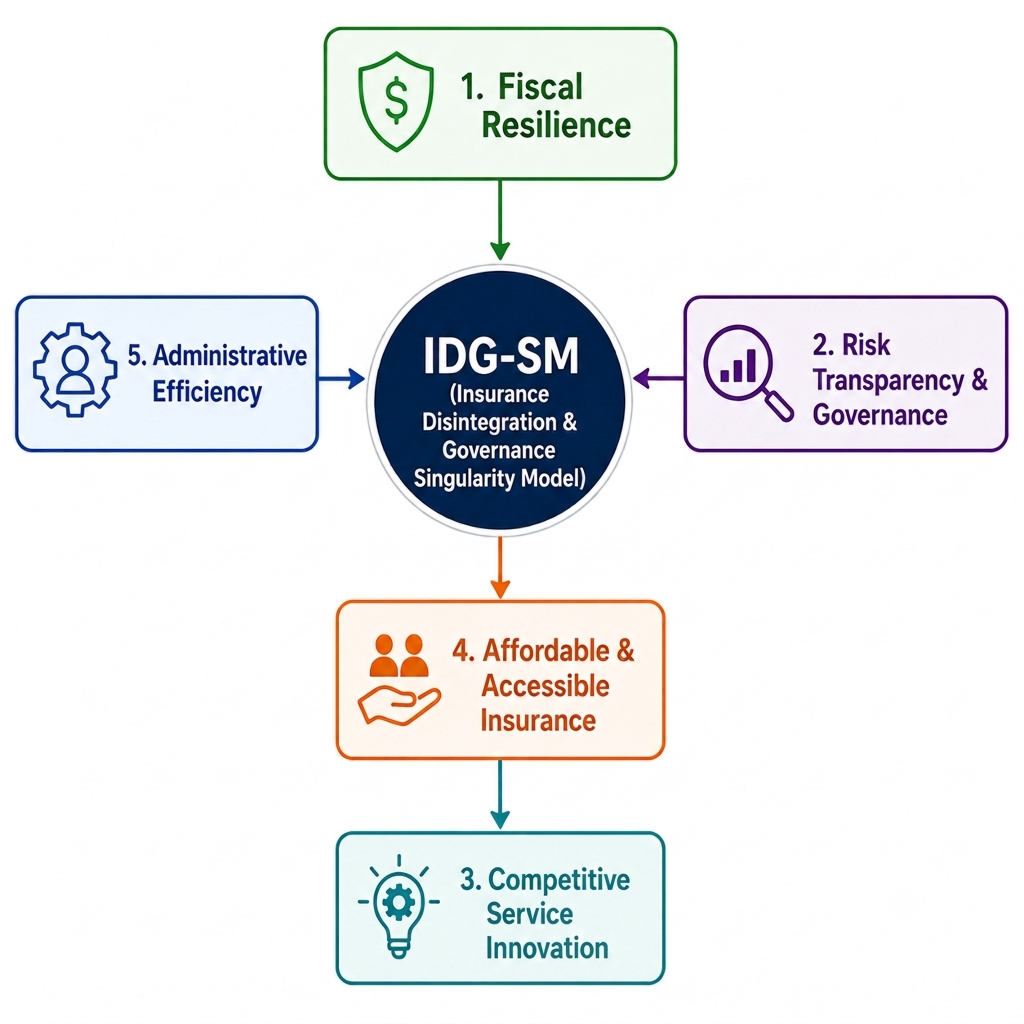
Traditional insurance systems are constrained by fragmented operations, layered intermediaries, and slow regulatory feedback loops. The Insurance Disintegration and Governance Model (IDG-SM) redefines this architecture by separating insurance into clearly governed functional layers.


How IDG-SM Operates (Structured Governance & Operational Leveling)

IDG-SM is built on a structured three-tier operational framework designed to segment core systemic workflows.

IDG-SM Operational Architecture Diagram

Governance & Regulation Layer

Centralized authority manages policy design, risk thresholds, compliance standards, and cross-sector insurance supervision.

Risk & Pricing Core

A computational engine aggregates national risk signals, actuarial models, and real-time data streams to standardize pricing logic and reduce opacity.

Client Operations Layer

Existing insurers, brokers, and service providers are retained as execution entities responsible for onboarding, customer service, claims processing, and distribution.

This separation ensures that governance is centralized for control and accountability, while operations remain distributed for scalability and market continuity.


Advantages of IDG-SM (Transparency, Efficiency, and System Integrity)

IDG-SM introduces structural advantages that directly address systemic inefficiencies in conventional insurance ecosystems:

Transparency by Design

Every pricing and risk decision is traceable through a unified governance and analytics layer.

Operational Efficiency

Reduced duplication of regulatory and underwriting functions across fragmented entities.

Fraud Minimization

Real-time verification and cross-entity data consistency significantly reduce claim manipulation and identity-based fraud.

Policy Responsiveness

Governments can adjust risk models dynamically in response to economic, environmental, or public health changes.

Scalable Infrastructure

Supports national-level deployment without disrupting existing market participants.

The result is a system that behaves less like a fragmented industry and more like a coordinated national infrastructure.


Economic Impact & Ecosystem Continuity (Citizens, Government, GDP, Industry)

For Citizens

Delivers faster claims resolution, fairer pricing structures, and improved accessibility through streamlined service channels.

For Government

Enables real-time oversight of national risk exposure, stronger regulatory enforcement, and improved fiscal planning through predictive insurance analytics.

For The Insurance Ecosystem

Existing players are not displaced but repositioned within the Client Operations Layer, preserving brokerage networks, underwriting expertise, claims management systems, and customer relationships - while removing redundant regulatory overhead.

For The Economy and GDP

Enhances capital efficiency by reducing systemic leakage from fraud, delays, and administrative duplication. The resulting stability improves investor confidence, strengthens financial resilience, and enables more accurate national risk pricing.

At its core, IDG-SM integrates advanced data systems, automation, and governance intelligence to create a transparent, efficient, and fraud-resistant insurance architecture - built for national-scale modernization rather than incremental reform.